
SMU Impact Stories: The Work You May Never See
Toshin Sequeira advises governments on how to build systems that outlast any single leader. Seven years out of SMU’s School of Economics, he has served as an embedded advisor to a Nobel Peace Prize laureate president, co-authored a World Economic Forum Global Risks Report, and helped build institutions from the ground up across Asia. The results, by design, are slow to surface.
The long game
In a government office in Asia, Toshin Sequeira saw how an entire scheduling system still depended on one person, a physical notebook and a series of WhatsApp photographs.
“Something as basic as a shared calendar can change how a country functions,” Toshin says. “That sounds trivial. But decisions fall out of a leader’s schedule. Citizens are affected by those decisions. The causal chain is very short.”
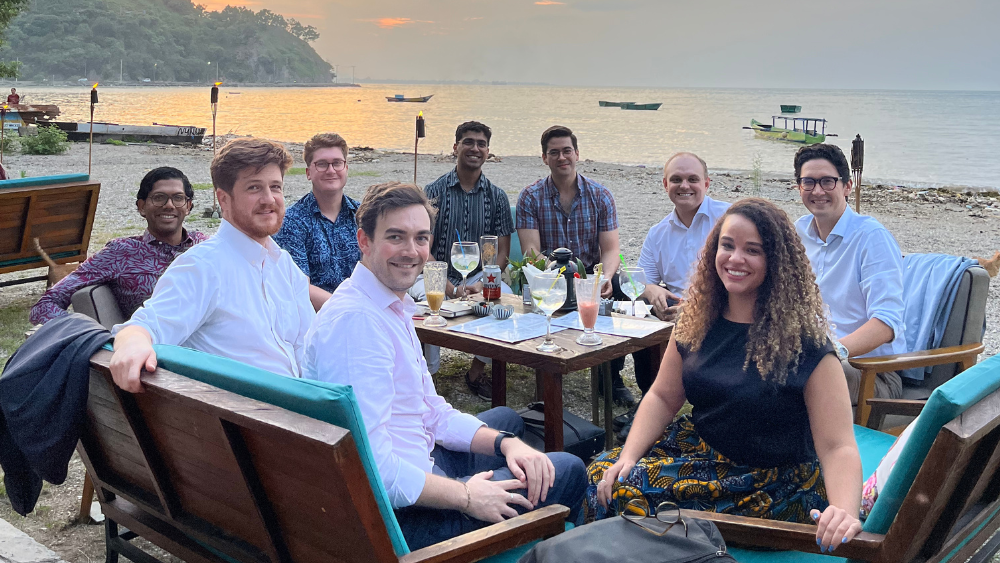
As Manager of Asia Pacific Advisory at the Tony Blair Institute for Global Change (TBI), Toshin has spent the past three years embedded in governments across the region, helping leaders build the structures that allow their countries to function — not the grand strategy, but the plumbing beneath it.
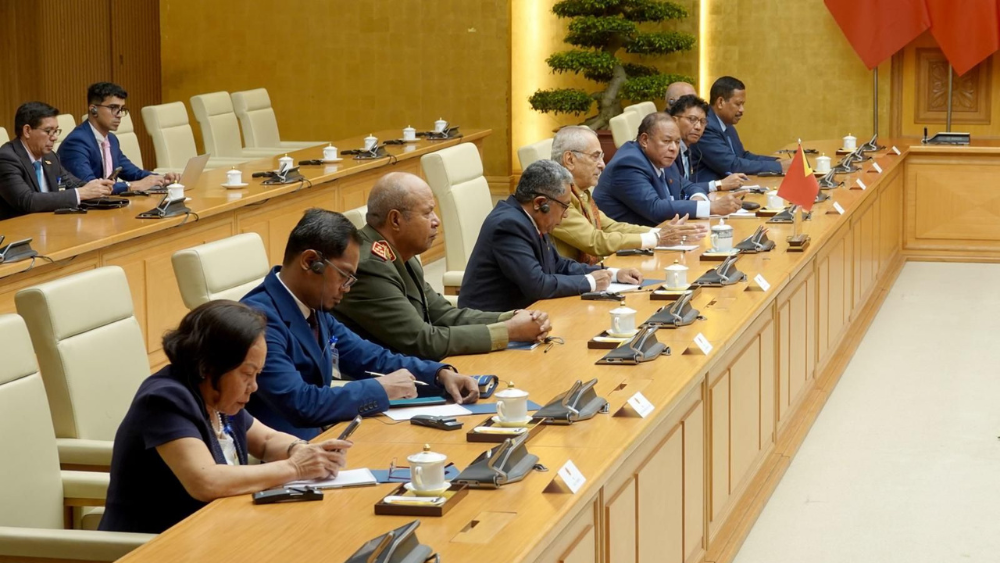
He served as an embedded advisor to President José Ramos-Horta of Timor-Leste, briefing him before bilateral meetings with the Presidents of China, India, and Vietnam. He has since worked across Vietnam, Timor-Leste, and Central Asia.
The idea Toshin returns to most often is from James Clear’s Atomic Habits: you do not rise to the level of your goals; you fall to the level of your systems. He encountered it before joining the Tony Blair Institute for Global Change, but it has since become something close to a professional framework.
“Most politicians arrive with a manifesto,” he says. “They get elected, make decisions, and expect things to happen. Tony Blair talks about this — he came in with a resounding majority and pulled the levers of power, and nothing happened. It wasn’t connected to anything.”
What Toshin and his colleagues build is what those levers connect to: the processes across ministries, the decision-making structures, and the single points of failure that bring a government’s capacity down when one person leaves or one system breaks. It is painstaking work that rarely makes headlines.
It is also, by design, slow to show results.
“The really difficult thing with social policy is that you can’t measure change immediately,” he says. “It takes years to see how you’ve moved the needle. So you have to become comfortable with qualitative signals — does this feel different? Are people making decisions faster? Do citizens feel like their lives are improving?”
The question of how to measure national resilience is one Toshin has worked on formally. Before joining TBI, he was one of the authors of Building Confidence in the Future: Towards a framework for measuring national resilience, developed for the UK Government’s National Preparedness Commission — an attempt to translate an inherently qualitative concept into something governments can actually act on.
“Resilience is one of those words that means everything and nothing,” he says. “The work is making it specific enough to understand where we are strong and determine where we remain vulnerable, to help us act in a timely and determined manner for future crises, whatever form they might take.”
Telling the world what to worry about
In 2023, while at Marsh McLennan, Toshin co-authored the World Economic Forum’s Global Risks Report — one of the most widely cited annual risk assessments in the world, read by governments, central banks, and institutional investors as a guide to the threats most likely to shape the coming decade.
The report that year identified the cost-of-living crisis, natural disasters, and geoeconomic confrontation among the most severe near-term risks. It was published at a moment of acute global instability — the first full year after the Russian invasion of Ukraine, with energy markets in disruption and inflation running at levels not seen in a generation.
“You’re trying to distil extraordinarily complex, contested information into something that can actually inform decisions,” Toshin says. “The risk is oversimplification. The work is making sure the simplification is insightful.”
It was, in miniature, the same challenge he faces in advising governments: how do you make systemic, long-horizon problems legible to people who are managing short-term pressures?
Building from nothing
In one Central Asian country, there was no central investment promotion agency when Toshin arrived. His team proposed, designed and began building the country’s first Economic Development Board. Their efforts centred on a single question: if you are a foreign company and you want to invest here, who do you call?
“We broke it down to first principles,” Toshin says. “What is the investor journey? Who do they need to speak to for a licence? Who do they need for manpower clearances? How do you create a single point of contact for that?”
The team ran simulations with cross-ministerial working groups, walking through the investor journey step by step, identifying where it broke down, and mapping who in government owned each decision.
“Sometimes,” he says, “people feeling like change is happening is enough. That’s not a compromise. That’s how you sustain the political will to keep going.”
Showing up
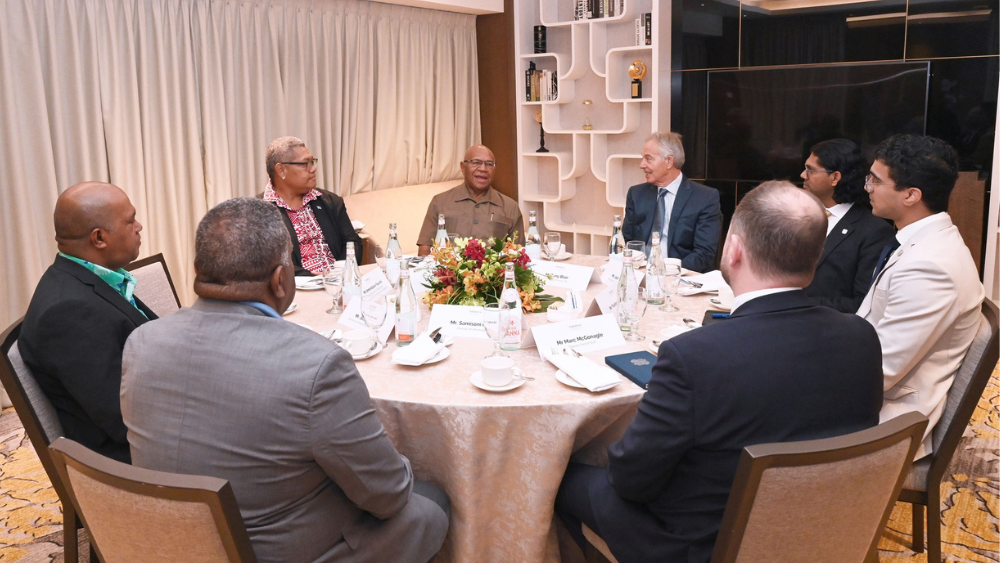
The model the Tony Blair Institute for Global Change uses is called embedded advisory. Rather than flying in with recommendations and flying out, the team relocates to the country for the duration of the project. Being there full-time changes what is possible.
“If you’re living there, you’re available to the leader 24/7,” Toshin says. “Crisis doesn’t choose a time to come up. It’s never convenient. And in those moments, you can either prove your value, or fall short.”
In his second year at the firm, leadership transitions left Toshin as the last person on the ground in a client country. He was junior, relatively new, and without the institutional weight of the colleagues who had gone before him.
“I thought there was no way I could win these clients over,” he says. “But I realised that just showing up matters. In a difficult situation, in a difficult context, if you show up with curiosity and you put in the effort, people give you more time than you’d expect.”
A mentor’s observation has stayed with him: the people who make an impact are the ones who run towards the fire, not away from it. His translation of it is practical rather than heroic.
“That doesn’t mean dramatic gestures,” he says. “It means choosing the harder path. Working on problems that don’t have quick fixes. Being the person who is still there when everyone else has found a reason to leave.”
Where it started
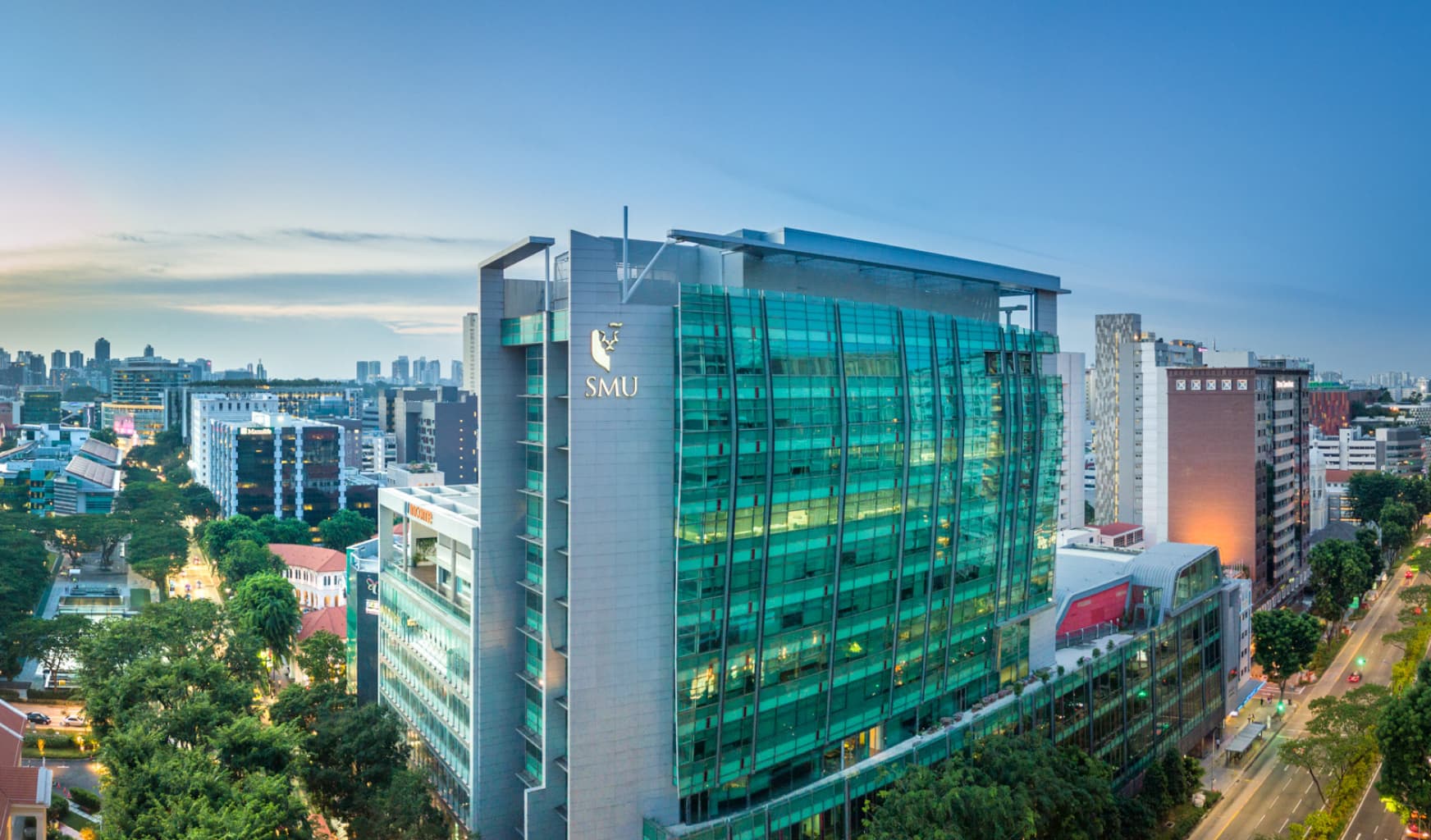
The thinking started at SMU, in a public policy task force convened by Dr John Donaldson, Associate Professor of Political Science at the SMU School of Social Sciences.
The brief was real, based on an actual policy question: understand the situation of single-parent families living in Singapore’s rental housing.
Toshin’s group went out and interviewed 40 to 50 single parents — at rental housing estates, at void decks, and in their homes. They spoke to single mothers and single fathers. They found that the income cap governing eligibility for rental housing assistance was too blunt: a parent earning S$1,500 a month with four children may be technically above the threshold but practically unable to manage.
The group submitted a formal paper recommending that eligibility be re-assessed by household need rather than income alone. The government reviewed it, and some of what they proposed influenced subsequent housing policy discussions.
“That experience changed how I think about policy work,” Toshin says. “You don’t just study systems. You enter them. You test your assumptions against people’s actual lives. The gap between what a policy looks like on paper and what it feels like to live under it — that gap is where the real work is.”
What impact actually means
“Is it the number of people you affect, or the depth of the change? Is it something you can measure, or something people feel?” Toshin asks, resisting a neat definition of impact.
“I don’t think the answer is fixed. Some things can be measured immediately. Others only become visible years later, after the moment that caused them has already passed.”
During the pandemic, he co-led a United Nations Sustainable Development Goals Student Programme across 82 hubs in 26 countries. Participants dialled in from wherever they were. Some did not have laptops. One joined from under a tree, using borrowed Wi-Fi from a nearby café.
“That stayed with me,” he says. “Not because it was dramatic, but because it made us all feel connected as a community. Someone sitting under a tree in another corner of the world, trying to participate in something larger than themselves. That reminds you both how unequal the world still is, and how much our shared values and aspirations can endure despite it.”
Twenty years from now, Toshin hopes people will remember him less for the countries he worked in or the titles he held than whether he stayed with difficult problems long enough to help move them forward.
“Most meaningful change is cumulative,” he says.
That is especially true in government, where impact often takes the form of systems that hold, processes that work, and people who work better together. Citizens may never know why something feels easier or faster. But, as Toshin puts it, “the outcome is that everyday life becomes slightly less difficult for someone you will probably never meet.”
For him, that is enough reason to keep doing the work.
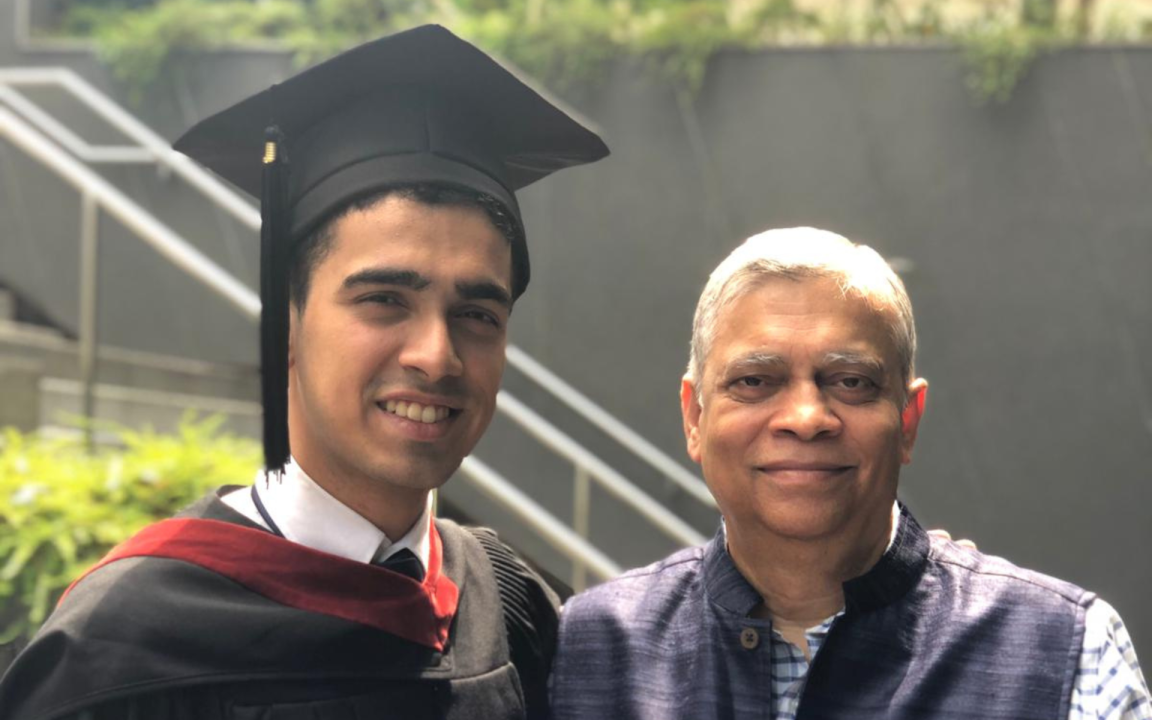
Toshin Sequeira (BSc Economics 2019) graduated from the School of Economics at Singapore Management University. He is the first and only SMU alumnus selected for the Schwarzman Scholars programme and received his master’s degree from Tsinghua University in Beijing. He is currently Manager for Asia Pacific at the Tony Blair Institute for Global Change.
The SMU Impact Stories series spotlights the journeys of our faculty, alumni, students, and partners who are driving positive change through education, research, and community engagement. Discover more stories here.