
SMU Impact Stories: From Problems to Communities - Pranav Krishna Prasad’s Journey of Impact
From pandemic-driven problem-solving to global start-up stages, SMU graduate Pranav Krishna Prasad’s journey shows how purpose-led entrepreneurship can build communities and create impact. Through ventures spanning shared retail spaces, sustainable batteries, and youth-led sustainability storytelling, his story highlights how SMU’s innovation ecosystem empowers students to turn curiosity into action—and adversity into meaningful change.
“People usually ask how many start-ups I’ve built. I think the better question is… why did I build them?”
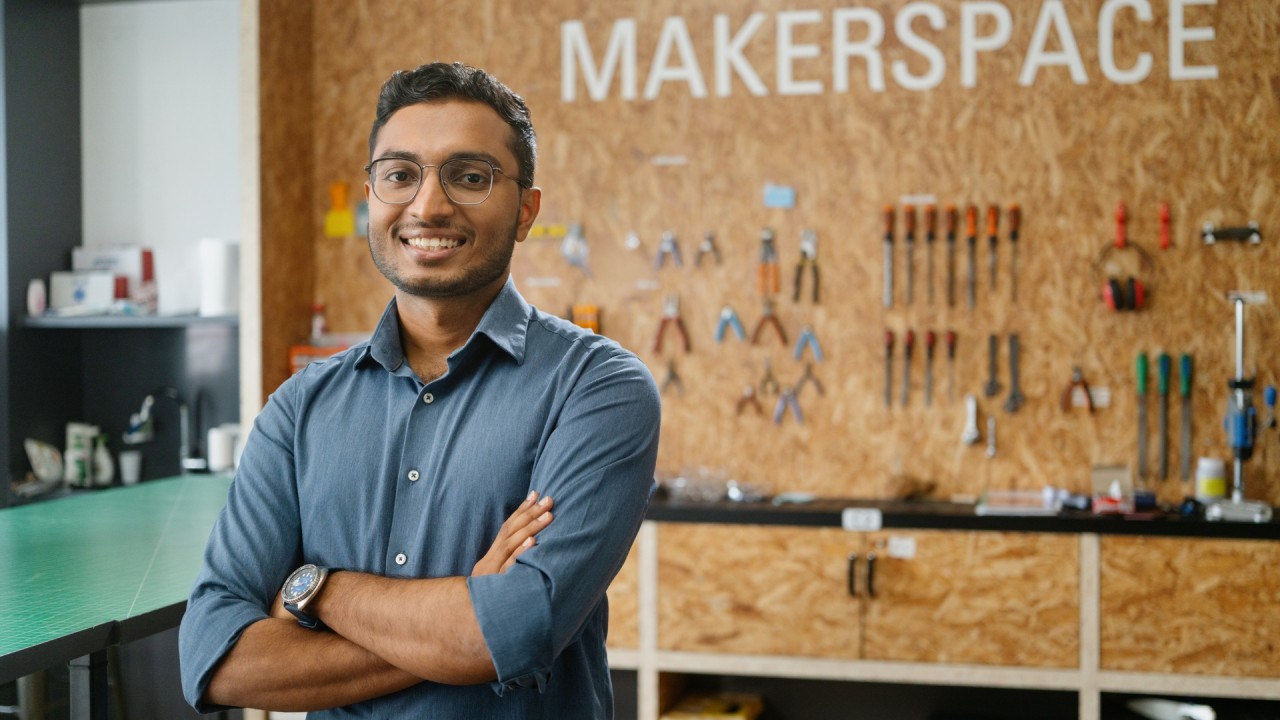
For Pranav Krishna Prasad (BBM, Class of 2025), entrepreneurship was never about collecting ventures. It was about confronting questions that refused to leave him alone.
How could local businesses survive a pandemic? Why do promising youth projects struggle to be heard? What might a sustainable battery look like if we built it from the ground up?
By the time he graduated from Singapore Management University (SMU), Pranav had helped shape three start-ups, raised over half a million dollars in funding, and stood on the global stage at TechCrunch Disrupt Startup Battlefield 2023. More than a record of achievements, his journey reflects the kind of bold, purpose-driven impact that SMU was built to inspire.
A University That Challenges Assumptions
When Pranav entered SMU’s Lee Kong Chian School of Business, his life had been defined by structure and precision. A former competitive air-rifle athlete, he had trained for years in a sport where control was everything. “You aim, you breathe, you shoot — the rules don’t change,” he recalls.
Entrepreneurship, by contrast, was unpredictable. It was iterative, fluid and full of risk — and that was exactly what drew him in. SMU’s seminar-style classrooms replaced passive learning with dialogue; professors and peers dissected ideas through debate rather than slides. “At SMU, ideas don’t live in PowerPoints,” he says. “They live in conversations.”
It was within the SMU Institute of Innovation & Entrepreneurship (IIE) — home to the Business Innovations Generator (BIG), which has supported more than 500 ventures collectively valued at over US$3 billion — that Pranav discovered what he calls his “mini Silicon Valley in Asia.” It was there that he learned to turn frustration into problem-solving, and curiosity into prototypes.
From Empty Spaces to Shared Survival
His first major experiment began in 2020, during the early months of COVID-19. As lockdowns emptied Singapore’s retail corridors, Pranav watched friends running social enterprises struggle to stay afloat. “They had heart, but no space,” he remembers. “Rent was the killer.”
That frustration became ShareRight, a platform that connects businesses with under-used spaces so they can share locations and split costs. The model benefits landlords, keeps local commerce alive, and prioritises social enterprises by waiving the platform fee.
Incubated at SMU IIE, ShareRight received IIE Acceleration Grant and mentorship support. Today the platform is scaling its operations and hiring its first full-time team. “When COVID hit,” he says, “I realised that survival could be collaborative. If one business stays open because another chose to share, that’s real impact.”
“Don’t fall in love with your solution — because you might always have to pivot.”
Learning Through Experimentation
While ShareRight established his reputation as a pragmatic problem-solver, Pranav’s next ventures tested very different skills.
He joined Flint, a deep-tech start-up pioneering paper-based chemistry to replace lithium in batteries — an innovation that made the team the only Asian contender to reach the global Top 20 at TechCrunch Disrupt. “Flint showed me how fragile innovation is,” he reflects. “One wrong decision, and the chemistry literally doesn’t work. But that’s what made it thrilling.”
Soon after, he co-founded EcoCupid, a youth-led media platform spotlighting sustainability initiatives across ASEAN and connecting them with funders and changemakers. What began as a student-run side project has grown into a cross-border storytelling network.
Across these ventures, a pattern emerged — an instinct to act on what others only notice.
Collectively, his ventures have attracted over S$500,000 in grants and investment — a testament not only to his drive but to the institutional scaffolding around him. “SMU let me fail without fear,” he says. “That’s how you learn to take real risks.”

Mentorship and Multipliers
Failure, for Pranav, was never a verdict — it was data. Within SMU IIE, he found mentors who understood that early-stage entrepreneurship is equal parts experiment and education. “My mentors saw potential before proof,” he says. “They didn’t give me answers; they asked better questions.”
That experience has shaped how he now gives back. Between consulting projects and product demos, he continues to mentor junior founders through the BIG community, guiding them from concept to prototype. “When juniors ask for feedback, I tell them: you don’t need permission to start. Just start.”
He pauses, then adds, “Someone once held the door open for me. I try to leave it open for the next.”
This culture of reciprocity — of paying forward the confidence once extended to you — defines SMU’s entrepreneurship ecosystem. Within BIG, founders often become mentors within months, creating a self-reinforcing cycle of innovation that mirrors the university’s broader ethos: learning beyond the classroom, impact beyond the individual.
Global Exposure, Local Relevance
Pranav’s journey also extended beyond Singapore. Through SMU’s Global Innovation Immersion (GII) programme, he spent a summer in Vietnam mentoring university founders and refining their investor pitches. The experience reshaped his understanding of context and communication. “It’s one thing to explain an idea in English,” he notes. “It’s another to make it resonate in a different culture. You realise entrepreneurship isn’t universal — it’s local everywhere you go.”
That cross-border awareness now informs how he approaches scale: carefully, and with sensitivity to local ecosystems. It reflects the kind of global perspective SMU encourages — one that connects classroom learning with real-world complexity.
Extending Impact Beyond Campus
Since graduating, Pranav’s journey has taken another meaningful turn. In October 2025, he was appointed to the Board of SCAPE Singapore — making him the youngest board member in the organisation’s history.
“Years ago, I used to work out of SCAPE’s shared spaces as a student founder,” he says. “Now I get to help reimagine what those spaces mean for the next generation.”
It’s a full-circle moment that captures how his journey from student entrepreneur to community builder continues to evolve. At SCAPE, Pranav is helping bridge the gap between traditional youth initiatives and emerging creative, digital, and entrepreneurial communities. “Real impact comes from listening first, assuming never,” he adds.
For him, this new chapter is about widening the definition of youth empowerment — and ensuring that every young person, whether a coder, artist, gamer, or changemaker, finds a place to belong.
Redefining Success
If Pranav once measured success by the number of ventures launched or funds raised, his definition has since matured.
“I’ve realised it’s not about exits or valuations,” he says. “It’s when someone tells me they felt seen because of a story we told — or they dared to start something because they saw us try.”
What endures, he believes, is not the company but the community that grows around it. “SMU didn’t just teach me to start companies,” he adds. “It taught me to build communities.”
That insight — that impact scales through others — lies at the heart of SMU’s approach to entrepreneurship education. By treating experimentation as a form of learning and collaboration as a form of leadership, the university continues to nurture changemakers who connect ideas with action.
Having just graduated, Pranav now divides his time between mentoring, product development, and exploring new ideas in sustainable innovation. “Every idea I’ve worked on has been a reason to stay curious,” he says with a grin. “That’s the part I never want to outgrow.”
About the SMU Institute of Innovation & Entrepreneurship
The SMU Institute of Innovation & Entrepreneurship (IIE) is the university’s innovation catalyst, supporting start-ups, student founders, and changemakers through incubation, mentorship, and research. Its Business Innovations Generator has nurtured over 500 start-ups since 2009, collectively raising more than US $555 million in funding. Learn more at iie.smu.edu.sg.
About the SMU Impact Stories
The SMU Impact Stories series spotlights the journeys of our faculty, alumni, students, and partners who are driving positive change through education, research and community engagement. Each story offers a window into the values that define Singapore Management University — from academic excellence and inclusive leadership to real-world impact and global relevance. Discover more stories here.