

From Adversity to Innovation: The Start-Up Journeys of SMU Student Entrepreneurs
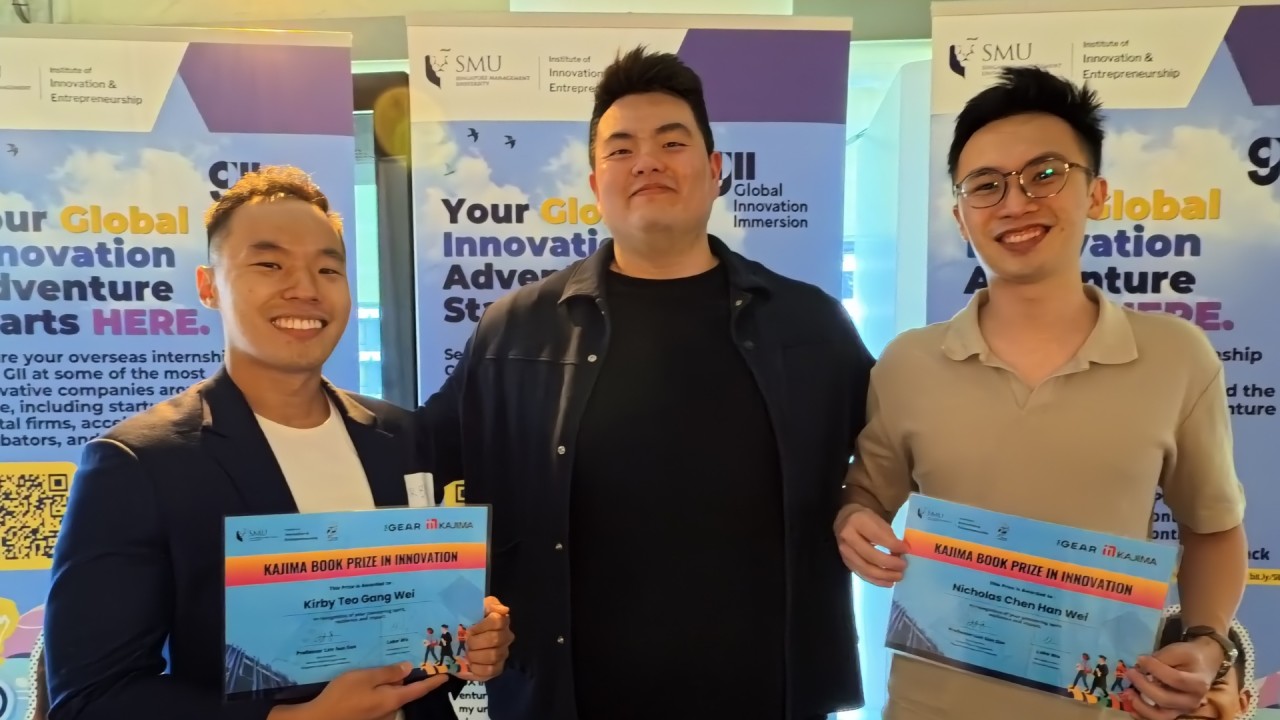
SMU graduates Kirby Teo and Nicholas Chen turned personal and financial setbacks into start-up success, supported by SMU’s entrepreneurial ecosystem. From mentorship and programmes to funding opportunities, their journeys show how resilience, combined with the right support, can transform adversity into innovation and meaningful impact — earning them the Kajima Book Prize in Innovation 2025.
Kirby Teo did not set out to build a start-up.
After losing a close friend to suicide, he found himself searching for a way to respond — not just to process the loss, but to create something that might help others facing similar struggles. That instinct would later take shape as TAKO Connects, an initiative focused on supporting mental, social, and physical well-being.
In the early days, progress was slow. While a student at SMU Lee Kong Chian School of Business (LKCSB), he worked on the idea largely on his own, unsure how to move it forward or who to build it with.
“I realised others might be going through the same darkness, so I decided to build something to help.”
A shift came during the L’Oréal Brandstorm 2025 competition. Working closely with two classmates while representing Singapore, Kirby found a shared sense of purpose and working style that had been missing. They would go on to form the founding team behind TAKO Connects.
With that, the idea began to take clearer shape. Through programmes such as the Business Innovations Generator (BIG) and the Student Entrepreneur Internship (SEI), he started testing and refining the concept more seriously, while mentorship from faculty including Assistant Professor Simon Schillebeeckx and Associate Professor Kenneth Goh provided perspective on building something sustainable. Support from the Summer Venture Awards (SVA) also gave him the runway to focus on developing the platform.
What began as a personal response gradually evolved into something more structured — a venture grounded in lived experience, with the aim of reaching others who might otherwise go unseen.

Rebuilding under pressure
Nicholas Chen’s path into entrepreneurship started more experimentally. During a hackathon, he and his co-founders began building a tool to make blockchain data within the Solana ecosystem more accessible. That project would later become SolanaFM.
The trajectory changed abruptly in November 2022.
The collapse of FTX wiped out half of the company’s US$3 million funding overnight, leaving the team with just a few months of runway.
With limited time and resources, the focus shifted quickly. Systems were streamlined, costs tightened, and priorities reassessed — all while Nicholas was completing his final year of studies at SMU School of Computing and Information Systems (SCIS). The work was less about growth and more about keeping the company viable.
Rather than stepping away, he chose to rebuild it.
The process forced a different level of discipline and clarity. Decisions had to be made quickly, often with incomplete information. Through programmes such as BIG and SEI, he continued developing both the technical and business aspects of the venture, while interactions with mentors and other founders sharpened his judgement under pressure.
What began as a setback became a turning point. In rebuilding SolanaFM, the company emerged on a more deliberate and resilient footing.
What stays with them
The two journeys are very different in origin — one shaped by personal loss, the other by financial shock. But both required the same thing: the willingness to continue building when the outcome was uncertain.
For Kirby, that meant turning an instinct to help into something tangible.
For Nicholas, it meant making difficult decisions to keep a company alive.
In 2025, both were recognised with the Kajima Book Prize in Innovation, awarded to graduating students who demonstrate resilience, adaptability, and entrepreneurial drive.
Their experiences reflect a broader reality of building something from scratch. Progress is rarely linear. It is shaped by false starts, difficult trade-offs, and moments where direction is unclear — as much as it is by ideas and ambition.
Where it begins
Not every idea starts with a clear plan. Some begin with a question, or a problem that does not have an obvious solution.
What matters is having the space to work through it — to test, build, and figure out what it could become.
Graduating students involved in innovation and entrepreneurship can also consider applying for the Kajima Book Prize in Innovation—register via the early interest form to receive updates on the application launch.