
Ideas Festival 2026: What Makes Work Meaningful? Rethinking the Future of Work
At the recent panel discussion during Ideas Festival 2026 held at SMU, researchers examined how AI is reshaping work—not just through efficiency, but by eroding its social and human dimensions. As Gen Z redefines ambition and automation transforms roles, high-touch jobs and human judgment are gaining importance. The discussion highlights a key question: what should work mean in an AI-driven future?
What if you have been asking the wrong questions about the purpose of work? This was one of the points discussed during a panel discussion held at Singapore Management University (SMU) during the Ideas Festival in March 2026.
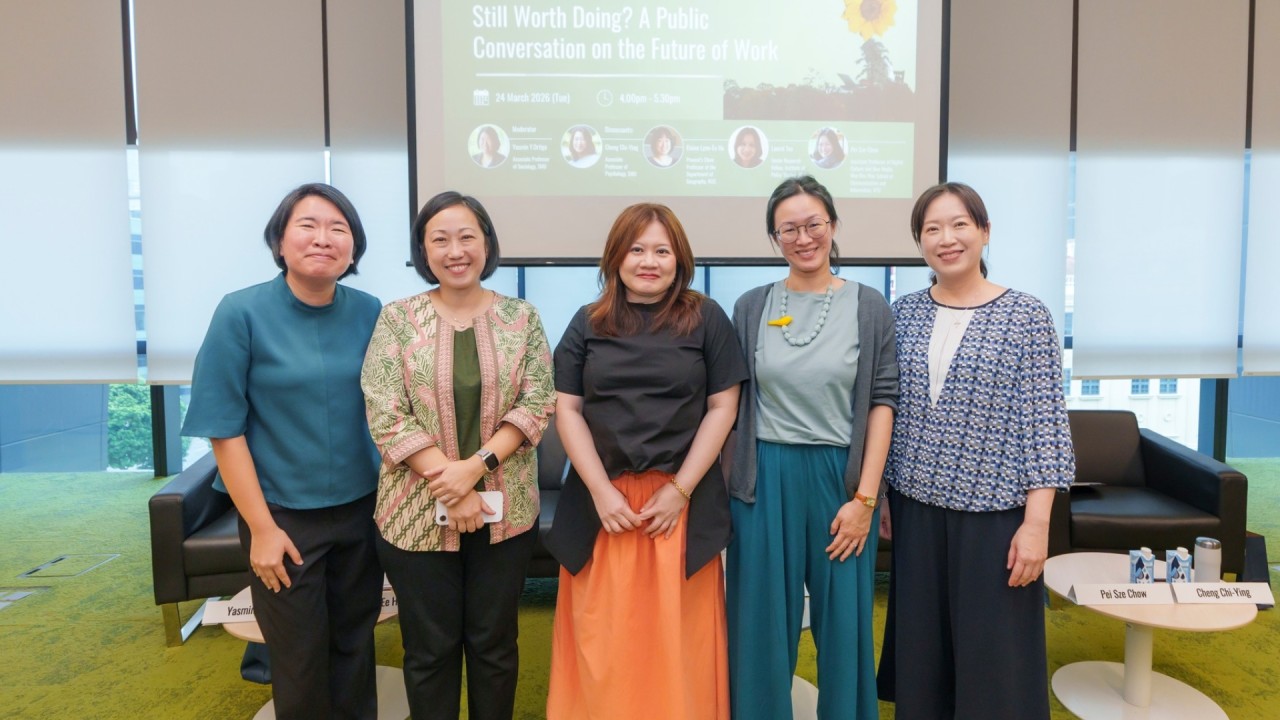
Amidst conversations about artificial intelligence (AI) adoption rates and job displacements, researchers from SMU, National University of Singapore (NUS), and Nanyang Technological University (NTU) gathered in a panel discussion titled Still Worth Doing? A Public Conversation on the Future of Work, to explore the definition of work and its evolving role, through the social science lens.
“A job is a position with defined tasks, usually tied to a wage,” explained SMU Associate Professor of Sociology Yasmin Ortiga, who chaired the panel discussion. “Work, as social scientists define, is broader. It is the time, energy, and emotion we invest in performing social tasks—paid or unpaid, visible or invisible. Work can give us meaning and purpose, or leave us feeling isolated and alone.”
The panellists included SMU Associate Professor of Psychology Cheng Chi-Ying; Dr Elaine Ho, Provost’s Chair Professor at the Department of Geography, NUS; Dr Laurel Teo, Senior Research Fellow at the Institute of Policy Studies, NUS; and Dr Chow Pei Sze, Assistant Professor of Digital Culture and New Media at the Wee Kim Wee School of Communication and Information, NTU.
How AI is reshaping and diminishing the social side of work
As AI drives greater efficiency at the workplace, it has been observed that the social dimension of work is gradually being eroded.
Asst Prof Chow, who has researched creative workers across Singapore and Asia, noted that generative AI has not only changed expectations of work efficiency, but also diminished the less tangible aspects of work.
“Everyone talks about getting things done faster and at a greater scale with AI,” she elaborated. “But with greater efficiency, the passion and social dimension of work have been lost.”
This shift is evident among animators and visual effects artists. Teams who used to collaborate in groups of five are now reduced to one-person teams using AI to replicate the output. While productivity has increased, opportunities for craft development, mentorship, and relationship-building—aspects that make work feel less transactional—have declined.
Dr Teo then moved the conversation from the technical to the ethical: “If AI can do a job, should we allow it to? It’s not only about its capability.”
She added that if decisions were left purely to market forces, cost efficiencies would often take precedence, highlighting the need for policy intervention to address AI’s broader social impact.
Why understanding what drives people at work matters more than ever
Beyond AI’s social impact, it is equally important to recognise what motivates people at work.
Assoc Prof Cheng has observed a shift in how ambition is defined among her students. In her annual “need for achievement” questionnaire to her undergraduates, scores have typically been well above the midpoint. However, her latest survey told a different story, with only one out of 71 students registering a high need for achievement.
This aligns with her broader research on Gen Z employees, who tend to value change, work-life balance, and staying authentic to themselves.
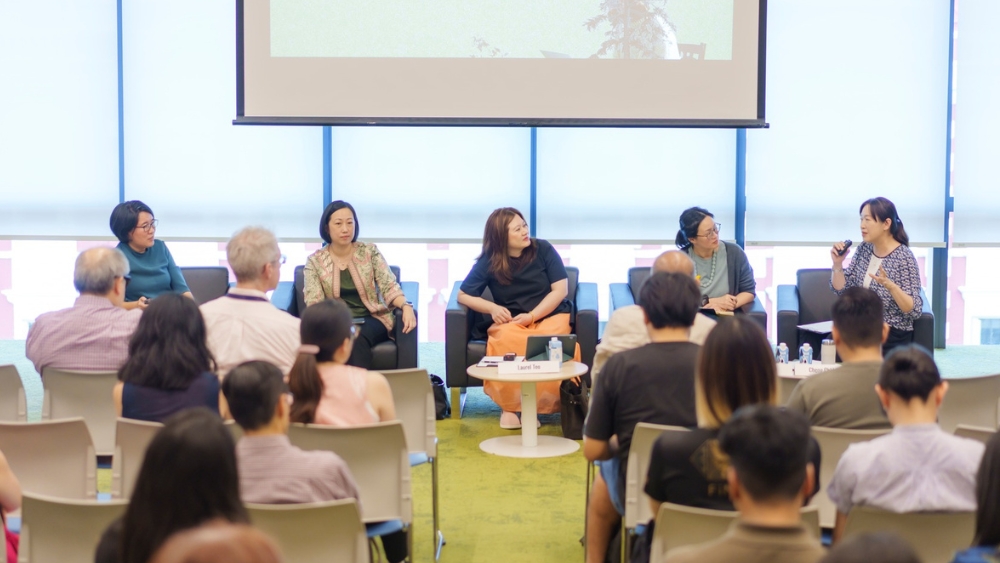
“They’re very driven for different purposes,” Assoc Prof Cheng commented, highlighting that traditional markers of success may no longer resonate with the workers of tomorrow.
She added that in the long run, the ability for continuous learning and cultivating genuine curiosity may matter more than proficiency in a specific task, especially as entry-level work becomes increasingly automated.
The increasing value of high-touch roles
As AI adoption accelerates and more work becomes automated, certain roles are gaining renewed importance.
During the panel discussion, the researchers differentiated “high-touch” roles—such as nursing, caregiving, and face-to-face service—and knowledge or process-based work. As the latter becomes increasingly automated, workers in these areas may feel more anxious and pressured to upskill, while those in high-touch roles face less immediate disruption.
Prof Ho pointed to a potential silver lining in this: as caregiving and hands-on work are harder to automate, these roles may finally receive the recognition they have long been denied.
“Individuals in sectors such as nursing, domestic work, and construction tend to be paid less because these jobs are not as valued,” she explained. “Yet, these roles may become more important in the future.”
Bringing sharper human judgment to the role
Regardless of the role, a key takeaway from the panel discussion is the importance of maintaining a human perspective at work.
Underscoring the value of humanities and social science training, Prof Ho shared that any role can be “high-touch” when approached with empathy and critical thinking.
In research, for instance, while AI can accelerate data analysis, deriving meaningful insights still requires human expertise.
Amidst the inevitable integration of AI in the workplace, the challenge now lies in mitigating over-reliance on these tools to ensure the human element remains.
Rethinking what makes work meaningful
The panel closed with a simple question: what makes a good job good? As the nature of work continues to evolve, the more important task may not be predicting which roles will survive automation, but defining what we want work to offer: purpose, growth, connection, or simply flexibility. In that sense, shaping the future of work is not just a technological challenge, but a human one.
At SMU, this question continues to be explored through ongoing efforts to examine the role of AI in the workplace. Initiatives such as the SMU Resilient Workforce Institute (ResWORK) bring together research and real-world insights to better understand these shifts and drive meaningful reskilling across society.